Researchers at the Institut des Sciences de la Terre (CNRS/Université Joseph Fourier/Université de Savoie/IRD/IFSTTAR) and the Institut de Physique du Globe de Paris (CNRS/Université Paris Diderot/IPGP), working in collaboration with Japanese researchers, have for the first time observed the response of Japanese volcanoes to seismic waves produced by the giant Tohoku-oki earthquake of 2011. Their […]
Archive for the ‘Featured Post’ Category
Giant earthquakes help predict volcanic eruptions
 August 4th, 2014
  Riffin
  Posted in Featured Post
  Tags: earthquakes, Riffin T Sajeev, Russel T Sajeev, volcanic, WFS, world fossil society
  No Comments »
Oldest land-living animal from Gondwana found ?
August 3rd, 2014 Riffin A postdoctoral fellow from Wits University has discovered the oldest known land-living animal from Gondwana in a remote part of the Eastern Cape. Dr Robert Gess, from the Evolutionary Studies Institute at Wits, discovered the 350-million-year-old fossilised scorpion from rocks of the Devonian Witteberg Group near Grahamstown. This unique specimen, which is a new species, […]
Posted in Featured Post Tags: fossil, Gondwana, oldest, Riffin T Sajeev, Russel T Sajeev, WFS, world fossil society No Comments »Oldest beetle found in amber
August 1st, 2014 Riffin An international team of scientists from Spain, France, and the U.S. has discovered and described a rove beetle that is the oldest definitive member of the tribe Omaliini that has ever been found in amber. The discovery and description were made possible through the use of the propagation phase-contrast X-ray synchrotron imaging technique, which allows […]
Posted in Featured Post Tags: Amber, Oldest beetle, Riffin T Sajeev, Russel T Sajeev, WFS, world fossil society No Comments »Dinosaurs fell victim to perfect storm of events
July 30th, 2014 Riffin Dinosaurs might have survived the asteroid strike that wiped them out if it had taken place slightly earlier or later in history, scientists say. A fresh study using up-to-date fossil records and improved analytical tools has helped palaeontologists to build a new narrative of the prehistoric creatures’ demise, some 66 million years ago. They found […]
Posted in Featured Post Tags: dinosaurs, Riffin T Sajeev, Russel T Sajeev, WFS, world fossil society No Comments »Leaf-mining insects destroyed with the dinosaurs, others quickly appeared
July 27th, 2014 Riffin After the asteroid impact at the end of the Cretaceous period that triggered the dinosaurs’ extinction and ushered in the Paleocene, leaf-mining insects in the western United States completely disappeared. Only a million years later, at Mexican Hat, in southeastern Montana, fossil leaves show diverse leaf-mining traces from new insects that were not present during […]
Posted in Featured Post Tags: dinosaurs, insects, Riffin T Sajeev, Russel T Sajeev, WFS, world fossil society No Comments »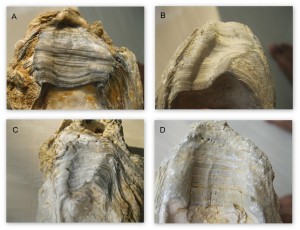
PRESENCE OF MIOCENE OYSTERS: RISE AND FALL OF A PALEO-ESTUARY IN THE EAST COAST OF INDIA
July 26th, 2014 Riffin Living oysters of Crassostrea Sp. are abundantly found on the east coast of peninsular India. Most of the living Crassostrea sp. is reported from Athankarai estuary near mandapam. The primary object of this study is to report the occurrence of fossils of Crassostrea sp. belonging to mio-pliocene outcrops from an ephemeral stream channel of Nambiyar/Thoppuvila […]
Posted in Featured Post Tags: Crassostrea, Miocene oysters, paleo-estuary, Riffin T Sajeev, Russel T Sajeev, WFS, world fossil society No Comments »The bend in the Appalachian mountain chain is finally explained
July 24th, 2014 Riffin The 1500 mile Appalachian mountain chain runs along a nearly straight line from Alabama to Newfoundland — except for a curious bend in Pennsylvania and New York State. Researchers from the College of New Jersey and the University of Rochester now know what caused that bend — a dense, underground block of rigid, volcanic rock […]
Jeju Island, Korea is a live volcano
July 23rd, 2014 Riffin In Jeju, Korea, a place emerging as a world-famous vacation spot with natural tourism resources, a recent study revealed a volcanic eruption occurred on the island. The Korea Institute of Geoscience and Mineral Resources (KIGAM) indicated that there are the traces that indicated that a recent volcanic eruption was evident 5,000 years ago. This is […]
Posted in Featured Post Tags: Jeju Island, Riffin T Sajeev, Russel T Sajeev, Volcano, WFS, world fossil society No Comments »Fossil of predators brain discovered
July 22nd, 2014 Riffin An international team of paleontologists has identified the exquisitely preserved brain in the fossil of one of the world’s first known predators that lived in the Lower Cambrian, about 520 million years ago. The discovery revealed a brain that is surprisingly simple and less complex than those known from fossils of some of the animal’s […]
Evidence of super-fast deep earthquake
July 20th, 2014 Riffin As scientists learn more about earthquakes that rupture at fault zones near the planet’s surface — and the mechanisms that trigger them — an even more intriguing earthquake mystery lies deeper in the planet. Scientists at Scripps Institution of Oceanography at UC San Diego have discovered the first evidence that deep earthquakes, those breaking at […]